Compressed-Air Root Investigation, Root Collar Excavation, Soil Decompaction, Vertical Mulching, and Construction-Related Tree Evaluation
Many important tree problems begin below ground.
A buried root flare, stem-girdling roots, compacted soil, construction damage, excess fill, root severance, poor drainage, or restricted rooting space may contribute to decline long before the cause becomes obvious in the crown.
Conventional digging can damage the very roots that need to be evaluated.
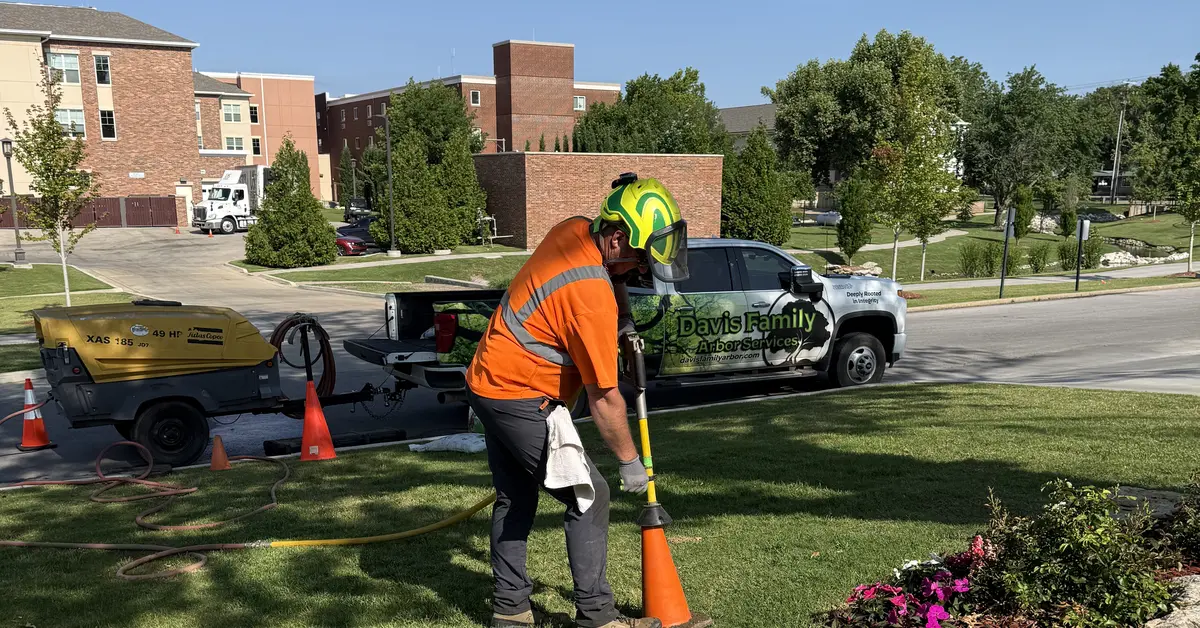
An AirSpade uses compressed air to loosen and move suitable soil while reducing the likelihood of severing woody roots compared with shovels, trenchers, or mechanical excavation. It is also an effective tool for addressing soil compaction by increasing soil pore space, which improves oxygen availability, water infiltration, and root growth conditions.
Davis Family Arbor Services provides professional AirSpade services throughout Tulsa, Broken Arrow, Jenks, Bixby, Sapulpa, and surrounding Oklahoma communities.
AirSpade investigations are led by Brad Davis, ISA Board Certified Master Arborist® MW-6328B, ISA Tree Risk Assessment Qualified, and ISA Florida Chapter Prescription Pruning Qualified.
AirSpade services are available for:
- Homeowners
- Commercial property owners
- HOAs
- Municipalities
- Public agencies
- Parks and campuses
- Developers
- Architects and engineers
- Property managers
- Contractors
- Attorneys
- Insurance professionals
- Historic and legacy properties
- Other managed landscapes
Potential applications include:
- Root Collar Excavation
- Stem-girdling root investigation
- Root-zone inspection
- Construction-damage investigation
- Root-location verification
- Soil decompaction
- Vertical mulching
- Root pruning preparation
- Utility and hardscape planning
- Tree preservation
- Tree forensic investigation
AirSpade investigation and treatment are fee-based professional services and are separate from free pruning or tree-removal estimates.
What Is an AirSpade?
An AirSpade is a pneumatic excavation tool that directs compressed air into the soil.
When soil conditions are suitable, the air stream breaks apart and moves soil particles while leaving many woody roots intact.
This allows selected portions of the root system or root collar to be exposed for inspection or treatment. It also allows compacted soil to be loosened without cutting roots, helping restore pore space necessary for healthy root function.
AirSpade work may help evaluate:
- Root location
- Root depth
- Root-flare development
- Stem-girdling roots
- Construction damage
- Root severance
- Root wounds
- Excess soil
- Mulch accumulation
- Soil layering
- Soil compaction and pore space limitations
- Buried infrastructure conflicts
- Planting depth
- Root-collar decay indicators
The AirSpade is a tool.
Its usefulness depends on:
- The question being investigated
- Soil conditions
- Operator technique
- Excavation depth
- Air pressure
- Root exposure
- Site restoration
- Professional interpretation
Soil Decompaction and Pore Space Improvement
Compacted soil reduces the amount of pore space available for air and water movement. This can limit root growth, reduce oxygen availability, and restrict overall tree health.
AirSpade soil decompaction works by fracturing compacted soil and increasing pore space without cutting major roots. This process can:
- Improve oxygen exchange in the root zone
- Increase water infiltration and drainage
- Encourage root growth into loosened soil
- Support beneficial soil biology
- Reduce stress caused by compacted conditions
AirSpade decompaction may be combined with other treatments such as radial trenching or vertical mulching to further improve soil structure.
Vertical Mulching
Vertical mulching is a targeted soil-improvement technique often performed using an AirSpade or similar tools.
It involves creating a series of vertical holes or columns within the root zone of a tree. These holes are typically filled with suitable organic material such as compost or a soil blend.
The purpose of vertical mulching is to:
- Increase soil pore space in compacted areas
- Improve localized air and water movement
- Introduce organic matter into the soil profile
- Encourage root growth into improved soil zones
- Reduce surface compaction effects
Vertical mulching is especially useful in areas where surface compaction is severe and roots are struggling to access oxygen and moisture.
The spacing, depth, and placement of vertical mulching holes should be carefully planned to avoid unnecessary root damage and to match the specific soil and tree conditions.
Is AirSpade Excavation Non-Invasive?
AirSpade excavation is better described as minimally disruptive rather than completely non-invasive.
It generally reduces the likelihood of cutting woody roots compared with conventional mechanical excavation.
However, the process may still:
- Expose fine roots
- Break or displace fragile absorbing roots
- Dry exposed roots
- Disturb soil structure
- Move mulch and organic material
- Expose utilities
- Alter the immediate root environment
- Create temporary site disturbance
AirSpade work should therefore be planned carefully and should account for:
- Soil moisture
- Temperature
- Wind
- Root exposure time
- Air pressure
- Nozzle distance
- Utility location
- Site access
- Post-excavation restoration
- Irrigation and aftercare
The objective is to obtain useful information or perform a justified treatment while minimizing avoidable root injury.
When AirSpade Investigation May Be Appropriate
AirSpade work may be appropriate when:
- The root flare is not visible
- The tree appears planted too deeply
- Stem-girdling roots are suspected
- Canopy decline cannot be explained from above-ground inspection
- Construction occurred near the tree
- Root severance is suspected
- Fill soil was added around the tree
- Soil compaction may be limiting root function
- A driveway, sidewalk, wall, utility, or foundation conflicts with roots
- Root-collar decay is suspected
- A tree has become unstable or developed root-plate movement
- Preservation planning requires direct root information
- ArboRadix® root detection indicates likely root locations requiring verification
- A legal, insurance, or forensic matter requires documentation
- A tree is being evaluated before construction begins
AirSpade excavation should address a defined question.
It should not be performed automatically on every declining tree.
Root Collar Excavation (RCX)
Root Collar Excavation is the controlled removal of soil, mulch, or accumulated material from around the base of a tree.
The objective is to expose the natural root flare and evaluate root-collar conditions.
RCX may help identify:
- Buried root flares
- Improper planting depth
- Stem-girdling roots
- Root-collar wounds
- Decay indicators
- Excess mulch
- Fill soil
- Construction impacts
- Abnormal root development
- Adventitious roots
- Trunk tissues buried below grade
- Buttress-root condition
A properly planted tree should generally show a visible transition from trunk to structural roots near the soil surface.
A tree that enters the ground like a telephone pole may be buried too deeply, surrounded by excess fill, or affected by abnormal root development.
RCX allows the root collar to be evaluated directly rather than inferred from the surface.