Carefully Planned Tree Removal for Homes, Businesses, Municipal Properties, and Managed Sites
Tree removal is sometimes necessary when a tree is dead, severely damaged, incompatible with a site, or associated with a level of risk that cannot be reasonably managed through pruning, support, target management, monitoring, or other mitigation.
Davis Family Arbor Services provides planned and controlled tree removal throughout Tulsa, Broken Arrow, Jenks, Bixby, Sapulpa, and surrounding communities. Our work is led by Brad Davis, ISA Board Certified Master Arborist® MW-6328B, ISA Tree Risk Assessment Qualified, and ISA Florida Chapter Prescription Pruning Qualified.
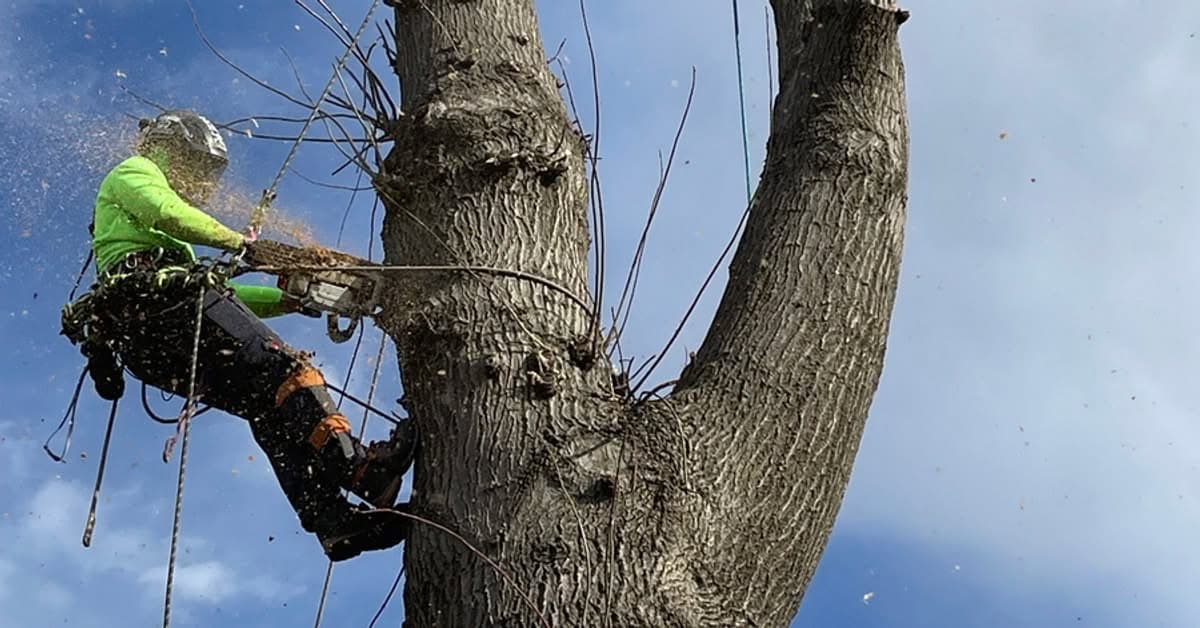
Before removal begins, we evaluate the tree, surrounding property, access, nearby structures, utilities, equipment requirements, and work-zone hazards. Depending on the tree and site, removal may involve directional felling, sectional dismantling, climbing and rigging, aerial-lift access, or crane-assisted operations.
Professional arborist consultations, diagnostic evaluations, formal tree risk assessments, forensic investigations, and written reports are separate fee-based services.
Preservation Is Considered Before Removal
Davis Family Arbor Services follows a preservation-first philosophy. Removal is not automatically recommended because a tree is large, mature, close to a structure, or showing one visible defect.
Where appropriate, we consider whether the concern can be managed through:
- Prescription pruning
- Crown reduction
- Clearance pruning
- Supplemental support
- Target management
- Root-zone improvement
- Plant health care
- Monitoring and reassessment
- Construction or site modifications
- Other reasonable risk-mitigation measures
When retention is no longer reasonable or removal best addresses the tree’s condition, site limitations, and the client’s objectives, we explain the basis for the recommendation and develop an appropriate removal plan.
When Tree Removal May Be Appropriate
Dead or Severely Declining Trees
Dead trees progressively lose wood strength and may become more difficult and hazardous to remove over time. Severe decline may also limit the tree’s ability to respond to environmental stress, pests, disease, pruning, or existing decay.
Removal may be considered when a tree is dead, has a poor prognosis, or no longer provides benefits sufficient to justify its continued management.
Advanced Structural Defects or Decay
Cracks, cavities, weak branch unions, root damage, internal decay, loss of anchorage, and previous failures may increase the likelihood of branch, trunk, or whole-tree failure.
These conditions should be evaluated in relation to:
- Their location and severity
- The tree’s species and structure
- Remaining wood and response growth
- Crown loading and exposure
- Root and soil conditions
- Nearby people, structures, vehicles, or infrastructure
- Available mitigation options
- The client’s risk tolerance and management objectives
A visible cavity, fungal fruiting structure, crack, or codominant union does not automatically require removal. Additional assessment or advanced diagnostics may be appropriate before making an irreversible decision.
Storm-Damaged or Partially Failed Trees
Severe thunderstorms, straight-line winds, tornadoes, lightning, ice, and saturated soils can cause branch failure, trunk splitting, root-plate movement, or whole-tree instability.
Some storm-damaged trees can be retained through pruning, support, or monitoring. Others may require immediate mitigation or removal because of extensive damage or rapidly changing conditions.
Conflicts with Structures or Infrastructure
Trees may conflict with buildings, pavement, drainage systems, utility corridors, planned construction, visibility, or site access.
Removal may be considered when the conflict cannot be reasonably managed through pruning, design changes, root protection, infrastructure modification, or other mitigation.
Construction and Development
Some trees may not be suitable for retention within a proposed development because of condition, species characteristics, location, anticipated root loss, grade changes, canopy conflicts, or long-term management needs.
Whenever possible, removal and preservation decisions should be made during project planning rather than after construction impacts have occurred.
Landscape and Property-Management Objectives
Selective removal may sometimes improve spacing, accommodate a site plan, reduce competition, or allow higher-priority trees to be retained.
These decisions should consider:
- Species (for example, fast-growing species like silver maple may outcompete slower, longer-lived species such as oak)
- Tree age and condition (such as removing a declining mature tree to preserve younger, healthier specimens)
- Root-zone overlap (for instance, closely spaced trees competing for limited soil resources)
- Canopy exposure (trees suddenly exposed after nearby removals may be more vulnerable to wind)
- Wind loading (trees with large, dense crowns may experience greater wind force)
- Remaining tree response (how nearby trees may react to increased light or space)
- Site use (such as clearing space for a driveway, patio, or building expansion)
- Long-term property objectives (including aesthetic goals, safety priorities, or planned landscape design)
Tree Removal in Tulsa and the Surrounding Metro
Tree removal throughout Tulsa County presents a wide range of site conditions.
Older neighborhoods may contain large mature trees over homes, garages, driveways, utilities, fences, and established landscapes. Newer developments may have narrow side yards, limited equipment access, irrigation systems, and closely spaced structures. Commercial, municipal, institutional, and HOA properties may involve public access, traffic control, scheduled work windows, and additional documentation requirements.
Every removal begins with an on-site evaluation of factors such as:
- Tree species, size, condition, and architecture (for example, a tall oak with a wide canopy requires different planning than a smaller ornamental tree)
- Lean and anticipated loading (the direction a tree naturally leans and how weight is distributed in the canopy can influence how it may fall or be dismantled)
- Root-plate and soil conditions (including signs of root failure, soil saturation, or instability at the base of the tree)
- Dead, broken, or suspended branches (often called “hangers,” which are partially detached limbs that may fall unexpectedly)
- Nearby homes, buildings, vehicles, fences, and landscaping (any structures or features that could be impacted during removal)
- Public areas, sidewalks, roads, and occupied spaces (locations where pedestrian or vehicle traffic must be managed or restricted)
- Overhead and underground utilities (such as power lines, communication cables, irrigation systems, or buried service lines)
- Equipment and crew access (including gate widths, slopes, and whether machinery like lifts or cranes can reach the tree)
- Work-zone setup and exclusion areas (designated safety zones where people and property are kept clear during operations)
- Suitable drop zones (pre-planned areas where branches or sections can be safely lowered or directed)
- Rigging or crane requirements (whether ropes, pulleys, or lifting equipment are needed to control large sections)
- Debris handling and cleanup needs (how branches, logs, and wood chips will be processed, removed, or left on site)
A site-specific work plan is developed before removal operations begin.
How Tree Removal Is Performed
The removal method depends on the tree and site. There is no single approach appropriate for every project.
Directional Felling
Where adequate space, tree condition, lean, and site conditions allow, a tree may be felled in a planned direction into a suitable drop zone.
Directional felling is not used when nearby structures, utilities, landscaping, limited space, tree instability, or other hazards require greater control.
Sectional Dismantling
On restricted sites, the tree may be removed progressively from the crown downward.
Branches and trunk sections are cut into manageable pieces and either:
- Lowered with rigging systems
- Controlled by crane
- Handled through aerial-lift access
- Directed into an established drop zone where safe
Small branches may be dropped into a designated and protected work area when doing so does not create an unreasonable risk of property damage.
Climbing and Rigging
Rope-based climbing systems may be used where aerial-lift access is limited or where climbing provides the best work positioning.
Professional rigging systems allow branches and trunk sections to be lowered in a controlled manner around homes, fences, landscape features, and other targets.
Aerial-Lift Access
Tracked lifts, spider lifts, or bucket trucks may be used where site access and ground conditions permit.
Ground protection may be installed to reduce soil compaction, rutting, and damage to lawns, pavement, irrigation, or root zones.
Crane-Assisted Removal
Cranes may be used for large, hazardous, storm-damaged, or restricted-access trees where lifting sections can reduce uncontrolled movement, climbing exposure, rigging loads, or impact to the surrounding site.
Crane use is selected according to the tree, access, setup area, lifting plan, nearby targets, and work-zone requirements. It is not automatically necessary for every large tree.
Equipment and Qualified Personnel
Depending on the project, tree removal operations may involve:
- Professional climbing systems (rope-based systems used by arborists to safely ascend, position, and work within a tree canopy)
- Advanced rigging equipment (including ropes, pulleys, friction devices, and lowering systems used to control the movement of branches and trunk sections)
- Tracked aerial lifts (compact lift machines with tracks that allow access over soft or uneven ground)
- Bucket trucks (vehicles with extendable booms and work platforms used to access tree canopies from the ground)
- Cranes (heavy lifting equipment used to remove large sections of a tree in a controlled manner)
- Compact loaders (small machines used to move logs, brush, and debris efficiently across a site)
- Chippers (machines that process branches and brush into wood chips for removal or reuse)
- Grapple trucks (trucks equipped with hydraulic arms used to load and transport large wood debris)
- Stump grinders (specialized machines that grind tree stumps below ground level)
- Ground protection mats (temporary panels placed on lawns or soil to reduce compaction and surface damage from equipment)
- Traffic and work-zone controls (cones, signage, barriers, or flagging used to manage pedestrian and vehicle movement around the work area)
Davis Family Arbor Services coordinates the equipment and qualified personnel appropriate for each assignment. Specialized equipment or portions of the production work may be provided through qualified production partners or subcontractors when appropriate.
Work Near Electrical Conductors and Utilities
Trees near energized electrical conductors require specialized evaluation and planning.
Work within applicable minimum approach distances must be performed by appropriately qualified line-clearance personnel or after the electrical utility has de-energized, isolated, relocated, or otherwise controlled the electrical hazard.
Service drops, secondary conductors, and communication lines should not be assumed safe based solely on appearance.
Davis Family Arbor Services evaluates the work area and coordinates with the utility provider or appropriately qualified contractors when required. Utility ownership, clearance requirements, scheduling, and service interruption decisions remain under the authority of the applicable utility.
Underground utility locating may also be required before equipment setup, stump grinding, excavation, or other ground-disturbing work. Standard public utility locating may not identify private irrigation, lighting, drainage, invisible fencing, or privately installed electrical systems.
What Is Included with Tree Removal
The exact scope is identified in the written proposal.
A standard removal proposal may include:
- Work-zone setup
- Planned felling or sectional dismantling
- Climbing, rigging, lift, or crane operations as specified
- Cutting and processing branches and trunk wood
- Removal of brush and wood from the property
- A stump cut reasonably close to existing grade
- General cleanup of the immediate work area
The proposal should identify whether the following are included or excluded:
- Stump grinding
- Surface-root grinding
- Hauling stump grindings
- Backfilling the stump area
- Soil or topsoil installation
- Seed, sod, or landscape restoration
- Firewood left on site
- Log removal
- Full-property cleanup
- Traffic control
- Utility coordination
- Permit assistance
- Replacement tree planting
- Post-removal site restoration
Work outside the written scope is performed only after the client approves any change in service or price.
Stump Grinding and Post-Removal Options
After a tree is removed, the stump and underground root system remain.
Stump grinding removes the visible stump and selected surface roots to an agreed depth. It does not remove the entire underground root system, and deeper roots generally remain in place to decompose over time.
Stump grinding may be appropriate when the client intends to:
- Install sod, seed, or landscaping
- Reduce a trip hazard
- Improve mowing access
- Prepare the general area for another use
- Remove a visible remnant of the tree
Replanting directly in the former stump location may require removal of grindings, additional excavation, imported soil, and relocation of the new planting site. The feasibility of replanting depends on the old root system, remaining wood, drainage, utilities, available rooting space, and the species selected.
New-Customer Stump Grinding Offer
New customers may receive standard stump grinding at no additional charge with a qualifying tree removal.
The offer applies only as stated in the written proposal and may exclude:
- Extensive surface-root grinding
- Hauling of grindings
- Imported soil or backfilling
- Landscape restoration
- Difficult or inaccessible sites
- Emergency work
- Multiple-stem or unusually large stumps
- Utility conflicts
- Other special conditions
Additional terms may apply.
How Much Does Tree Removal Cost in Tulsa?
Tree removal pricing depends on the tree, the property, the work method, and the agreed scope.
An on-site visit allows us to evaluate the work and provide a written project price.
Factors Affecting Tree Removal Cost
Tree Size and Architecture
Large trees, wide crowns, multiple stems, overextended branches, codominant trunks, and complex architecture may require more time, equipment, rigging, and personnel.
Tree Condition
Dead, decayed, storm-damaged, partially failed, or unstable trees may require different climbing, access, or lifting methods than sound standing trees.
Location and Nearby Targets
Trees near homes, garages, utilities, fences, vehicles, pools, landscape features, roads, sidewalks, or public areas generally require more controlled operations.
Site Access
Narrow gates, fenced yards, slopes, soft ground, septic systems, irrigation, overhead obstructions, and limited equipment setup areas can affect the removal method and production time.
Equipment Requirements
Aerial lifts, cranes, compact loaders, ground protection, traffic control, and specialized rigging may affect project pricing.
Debris and Wood Handling
The size and amount of wood, hauling distance, disposal requirements, firewood requests, and grapple-truck access may affect cost.
Stump and Restoration Work
Stump grinding, surface-root grinding, hauling grindings, backfilling, and landscape restoration are separately defined when applicable.
Permits and Utility Coordination
Some projects may require property-owner authorization, HOA approval, municipal review, right-of-way coordination, traffic control, or utility involvement.
Clear Written Proposals
The written proposal identifies the agreed work, included services, exclusions, and project price.
Any client-requested changes or newly discovered conditions that materially affect the work will be discussed before additional services or charges are authorized.
Examples may include:
- Hidden utilities
- Unmarked private infrastructure
- Restricted access not disclosed before scheduling
- Changes in site condition
- New storm damage
- Additional trees or branches requested by the client
- Unexpected regulatory or utility requirements
Emergency Tree Removal in Tulsa
Storms, saturated soils, ice, wind, lightning, and previous structural defects may create urgent tree conditions.
Emergency situations may include:
- Trees uprooted onto homes, garages, vehicles, or structures
- Partially failed trees
- Split trunks or major branch unions
- Suspended or storm-broken branches
- Trees blocking access roads, driveways, gates, or public routes
- Root-plate movement or rapidly increasing lean
- Trees or branches affecting essential utilities
- Conditions presenting an immediate threat to occupied areas
A partially failed tree or suspended branch can change rapidly. The work area should be isolated, and people should avoid standing, parking, or working beneath the affected tree.
Response time depends on weather, access, utility hazards, crew availability, regional storm demand, and site conditions.
Arborist Evaluation and Tree Risk Assessment
A tree removal estimate identifies the anticipated production work and price. It is not automatically a formal tree risk assessment.
A professional arborist consultation or formal tree risk assessment may be appropriate when:
- The client wants to determine whether removal is necessary
- Preservation alternatives need to be considered
- The tree has complex defects or suspected internal decay
- A written risk rating is needed
- The matter involves an HOA, municipality, insurer, attorney, or property transaction
- Competing professional opinions exist
- Advanced diagnostic testing may affect the decision
Formal tree risk assessments, advanced diagnostics, forensic investigations, and written reports are separate professional consulting services.
Insurance Documentation
Homeowners insurance may cover certain tree-removal expenses when a fallen tree causes covered damage or blocks specified access, subject to policy terms, exclusions, deductibles, and limits.
Preventive removal of a standing tree is commonly considered a property-maintenance expense, even when the tree has visible defects. Coverage must be confirmed by the property owner with the insurance carrier or adjuster.
Davis Family Arbor Services can provide:
- Site photographs
- Work descriptions
- Written proposals
- Itemized invoices
- Emergency-service documentation
- Photographs of storm damage
- Supporting arboricultural observations when included in the scope
We do not determine coverage or guarantee reimbursement. The property owner remains responsible for payment unless a different written arrangement has been approved.
Property Protection During Tree Removal
Protecting the surrounding property is part of removal planning.
Before work begins, we evaluate:
- Equipment access
- Ground conditions
- Structures
- Hardscape
- Irrigation
- Utilities
- Fences
- Landscape features
- Work-zone boundaries
- Debris handling
- Public or pedestrian access
Depending on site conditions, protection measures may include:
- Controlled rigging
- Crane lifting
- Ground protection mats
- Designated drop zones
- Temporary traffic or pedestrian controls