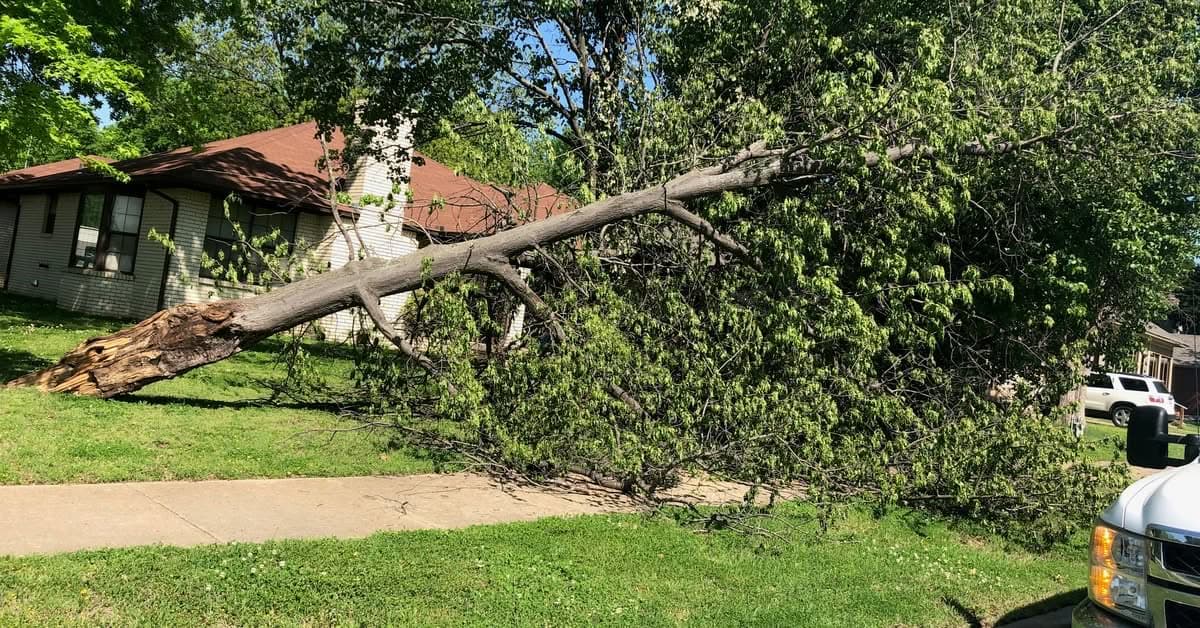
Emergency Response for Fallen Trees, Storm Damage, Broken Branches, and Urgent Tree Conditions
Tree conditions can change quickly during severe weather.
High winds, thunderstorms, tornadoes, lightning, ice, saturated soils, and previous structural defects may cause branches, trunks, or entire trees to fail with little warning. When a tree falls onto a home, blocks access, damages property, or leaves broken branches suspended above an occupied area, a prompt and carefully planned response is important.
Davis Family Arbor Services provides 24/7 emergency tree response throughout Tulsa, Broken Arrow, Jenks, Bixby, Sapulpa, and surrounding communities.
Emergency work is led or coordinated under the direction of Brad Davis, ISA Board Certified Master Arborist® (MW-6328B), ISA Tree Risk Assessment Qualified (TRAQ), and ISA Florida Chapter Prescription Pruning Qualified (PPQ).
If no one answers immediately, leave a detailed message and send photographs when requested. Calls are prioritized according to the urgency of the condition, risk to people, blocked access, utility involvement, site conditions, and available resources.
Calling the emergency line does not guarantee immediate arrival. Response time depends on weather, travel conditions, utility hazards, regional storm demand, crew availability, equipment requirements, and safe access to the property.
What Is an Emergency Tree Condition?
An emergency tree condition is generally one that presents an immediate or rapidly developing concern involving people, structures, essential access, utilities, vehicles, or public spaces.
Examples may include:
- A tree that has fallen onto a home, garage, vehicle, or other structure
- A partially failed tree that remains standing
- A split trunk or major branch union
- A large broken branch suspended in the crown
- A branch hanging over a roof, driveway, roadway, sidewalk, or occupied area
- A tree blocking a driveway, gate, access road, or emergency route
- Root-plate movement or a rapidly increasing lean
- A storm-damaged tree contacting or approaching electrical conductors
- A tree obstructing a public roadway or municipal facility
- A failed tree affecting commercial, institutional, HOA, or public property
- A condition that is actively changing during or after a storm
Not every concerning tree requires emergency removal. Some situations can be temporarily isolated and evaluated during normal business hours. Others require immediate mitigation to reduce exposure or restore essential access.
What to Do When a Tree Fails
Keep People Away
Do not allow people, pets, vehicles, or equipment beneath a broken branch, partially failed tree, or suspended tree section.
The condition may continue to change, particularly during wind, rain, or saturated soil conditions.
Avoid Moving the Tree Yourself
Do not cut, pull, push, climb, or attempt to stabilize a failed tree unless you are properly trained and equipped.
Trees and branches may be under stored mechanical tension or compression. Cutting the wrong location may cause sudden movement, splitting, rolling, or additional failure.
Watch for Electrical Hazards
Assume every overhead conductor is energized.
Do not touch:
- The tree
- A branch contacting a line
- A fence touching the tree
- A vehicle beneath the tree
- Nearby equipment or debris
Stay well away and contact the electrical utility or emergency services when conductors are involved.
Call Emergency Services When Necessary
Call 911 when there is:
- An immediate threat to life
- A fire
- A medical emergency
- A tree blocking emergency access
- A downed electrical conductor
- A dangerous condition affecting a public roadway
Document the Condition Safely
When it can be done from a safe location, take photographs or video showing:
- The entire tree
- The failed portion
- The affected structure or property
- The base of the tree
- Nearby utility lines
- Access to the work area
- The surrounding site
Do not enter the drop zone or stand beneath a damaged tree to obtain better photographs.
Emergency Tree Services We Provide
Emergency Tree Assessment
An initial emergency assessment helps determine:
- What has failed
- Whether additional failure appears possible
- What people or property may be exposed
- Whether utilities are involved
- Whether the site can be safely accessed
- What immediate mitigation is reasonably available
- What equipment and qualified personnel may be required
An emergency site assessment is focused on immediate conditions and work planning. It is not automatically a formal ISA tree risk assessment or written consulting report.
Storm-Damage Mitigation
Emergency mitigation may include:
- Removing failed branches from structures
- Removing suspended branches
- Stabilizing or isolating the work area
- Reducing selected broken branches
- Removing unstable tree sections
- Clearing essential access
- Removing a partially or completely failed tree
- Coordinating specialized equipment
- Documenting visible storm damage
The immediate objective is to address the urgent condition. Additional pruning, restoration, stump grinding, landscape repair, or management of other trees may be scheduled separately.
Emergency Tree Removal
Emergency removal may be necessary when:
- A tree has completely failed
- A partially failed tree cannot be reasonably stabilized
- The remaining structure is rapidly changing
- The tree blocks essential access
- Continued failure could affect an occupied structure or public area
- Utility coordination requires removal
- Other practical mitigation options are not available
Depending on the site, emergency removal may involve:
- Climbing and rigging
- Tracked aerial lifts
- Bucket trucks
- Cranes
- Compact loaders
- Grapple trucks
- Specialized cutting and stabilization methods
- Traffic or pedestrian controls
Emergency Access Clearing
Fallen trees may block:
- Driveways
- Gates
- Private roads
- Commercial entrances
- Municipal access routes
- Parking areas
- Emergency-service access
When practical, the initial work may focus on creating safe, limited access before the remainder of the tree and debris are removed.
Crane-Assisted Emergency Operations
Cranes may be appropriate when a failed or unstable tree is:
- Resting on a structure
- Too unstable to climb
- Suspended above a home or building
- Located in a restricted work area
- Too large for conventional rigging
- Positioned where lifting can reduce additional property impact
Crane use depends on access, setup space, soil conditions, electrical hazards, lifting requirements, weather, and equipment availability.
Emergency Work Near Electrical Conductors
Tree work near energized electrical conductors presents a potentially fatal hazard.
Work within applicable minimum approach distances must be performed by appropriately qualified line-clearance personnel or after the utility has de-energized, isolated, relocated, or otherwise controlled the electrical hazard.
Davis Family Arbor Services may coordinate with:
- Public Service Company of Oklahoma
- Municipal electrical providers
- Rural electric cooperatives
- Communication utilities
- Qualified line-clearance contractors
- Emergency responders
The utility determines how and when its electrical system will be controlled.
Davis Family Arbor Services cannot override utility procedures, energization status, outage priorities, or restoration schedules.
Emergency Tree Response for Municipalities and Public Agencies
Davis Family Arbor Services provides emergency tree response and coordination for:
- Municipalities
- Public agencies
- Parks
- Schools
- Campuses
- Public facilities
- HOAs
- Commercial properties
- Apartment communities
- Institutional properties
- Roadways and managed public spaces
Municipal and public-property assignments may involve:
- Emergency access restoration
- Tree and branch removal
- Public-area isolation
- Traffic and pedestrian control
- Utility coordination
- Site documentation
- Prioritization of multiple affected trees
- Follow-up tree risk assessment
- Storm-response planning
- Debris handling and removal coordination
Response is subject to procurement requirements, authorization, access, equipment needs, and available resources.
Emergency Response Versus a Formal Tree Risk Assessment
An emergency response focuses on immediate conditions and practical mitigation.
A formal tree risk assessment is a separately scoped professional service that may include:
- Defined targets
- Specified assessment period
- Likelihood-of-failure ratings
- Likelihood-of-impact ratings
- Consequence ratings
- Overall risk ratings
- Written management recommendations
- Photographic documentation
- Reassessment recommendations
A formal tree risk assessment may be appropriate after emergency conditions are stabilized, especially when:
- Portions of the tree remain standing
- Other trees were exposed to similar storm loading
- A written risk rating is needed
- The property is managed by an HOA, municipality, institution, or commercial owner
- Insurance or legal documentation is requested
- Preservation of the remaining tree is being considered
- Advanced diagnostics may affect the long-term recommendation
Formal tree risk assessments, forensic investigations, advanced diagnostics, and written consulting reports are separate fee-based services.
Tree Forensic Investigation After Failure
A failed tree may leave evidence that helps explain what occurred.
A forensic investigation may be appropriate when the failure involves:
- Personal injury
- Significant property damage
- Construction activity
- Questions about previous tree condition
- Disputed maintenance responsibilities
- Neighboring properties
- Insurance disagreements
- Municipal or public-property claims
- Potential litigation
- Questions involving pruning, roots, decay, or site changes
Forensic services may include:
- Photographic documentation
- Examination of the failure surface
- Tree and stump measurements
- Root-plate inspection
- Site and target documentation
- Weather-history review
- Maintenance-record review
- Construction-history review
- Advanced diagnostics on remaining portions
- Written professional opinions
Important evidence may be lost when the tree is cut, moved, chipped, ground, or removed.
When a legal or insurance dispute is reasonably anticipated, contact an arborist and legal counsel before authorizing complete disposal of the tree whenever it is safe and practical to do so.
Emergency Tree Service and Insurance Documentation
Homeowners or commercial property insurance may cover some emergency tree expenses when a tree causes covered damage or blocks access specified by the policy.
Coverage varies by:
- Policy language
- Cause of loss
- Property affected
- Whether a covered structure was damaged
- Access limitations
- Deductibles
- Coverage limits
- Exclusions
- Carrier requirements
Davis Family Arbor Services can provide documentation such as:
- Site photographs
- Storm-damage photographs
- Written work descriptions
- Proposals
- Itemized invoices
- Equipment and labor descriptions
- Emergency-response notes
- Supporting arboricultural observations when included in the scope
Davis Family Arbor Services does not determine insurance coverage, interpret policy language, act as a public adjuster, or guarantee reimbursement.
The client remains responsible for payment unless a different written arrangement has been approved.
Working With Insurance Adjusters
When an insurance claim is involved:
- Contact the insurance carrier as soon as practical.
- Ask what documentation the carrier requires.
- Photograph the condition from a safe location.
- Preserve damaged property and tree evidence when practical.
- Do not delay urgently needed work when people or structures remain exposed.
- Keep copies of proposals, invoices, photographs, and communications.
- Request a separate consulting report when the carrier requires professional arboricultural analysis beyond the emergency work invoice.
Emergency mitigation and insurance claim evaluation are different services. The emergency crew addresses the tree condition; the insurance carrier determines policy coverage.
What Is Included in Emergency Tree Service?
The emergency proposal or work authorization identifies the agreed scope.
Depending on the situation, emergency work may include:
- Mobilization
- Initial site evaluation
- Work-zone setup
- Access clearing
- Branch or tree removal
- Climbing and rigging
- Aerial-lift operations
- Crane-assisted operations
- Debris processing
- Hauling
- General cleanup of the immediate work area
- Photographic documentation
- Temporary mitigation
The following may be quoted separately:
- Stump grinding
- Surface-root grinding
- Hauling stump grindings
- Backfilling
- Landscape restoration
- Roof or structural repairs
- Fence repair
- Utility repairs
- Soil installation
- Replacement planting
- Detailed forensic reporting
- Formal tree risk assessment
- Advanced diagnostics
- Management of unaffected trees
- Return visits after the emergency condition is stabilized
Emergency work may prioritize immediate mitigation over final cleanup or restoration.
Emergency Tree Service Pricing
Emergency tree-service pricing depends on:
- Time of response
- Tree size
- Tree condition
- Failure configuration
- Structures or vehicles involved
- Electrical hazards
- Access
- Weather
- Crew size
- Equipment requirements
- Crane or lift availability
- Traffic-control needs
- Debris volume
- Regional storm demand
- Duration of work
- Disposal and hauling requirements
Emergency work may cost more than scheduled tree work because it can require rapid mobilization, specialized equipment, after-hours labor, additional personnel, utility coordination, and work under difficult or changing conditions.
Whenever practical, the anticipated scope and pricing are discussed before work begins. Conditions that cannot be safely evaluated until material is removed may require changes to the work plan.
Property Protection During Emergency Work
Emergency operations often occur under difficult conditions.
The site may contain:
- Damaged structures
- Broken utilities
- Saturated soil
- Restricted access
- Unstable branches
- Shifting tree sections
- Roofing debris
- Broken fences
- Damaged vehicles
- Standing water
- Hidden infrastructure
- Other storm hazards
Depending on the site, protective measures may include:
- Controlled rigging
- Crane lifting
- Ground protection mats
- Equipment-route planning
- Work-zone barriers
- Traffic or pedestrian control
- Progressive debris removal
- Temporary access restrictions
- Coordination with emergency services or utilities
Protective measures reduce avoidable impacts but cannot eliminate every effect associated with emergency access, heavy equipment, unstable material, saturated ground, or urgent mitigation.
Why Choose Davis Family Arbor Services?
- Led by an ISA Board Certified Master Arborist®
- ISA Tree Risk Assessment Qualified
- 24/7 emergency response availability
- Preservation alternatives considered where practical
- Controlled rigging capabilities
- Crane-assisted removal coordination
- Tracked aerial-lift access
- Ground protection equipment
- Tree forensic investigation capabilities
- Insurance documentation support
- Municipal and public-property response
- Written proposals and work authorizations
- Fully insured
- Family owned and locally operated
Service Area
Davis Family Arbor Services provides emergency tree response throughout the Tulsa metropolitan area, including:
- Tulsa
- South Tulsa
- Broken Arrow
- Jenks
- Bixby
- Sapulpa
- Glenpool
- Sand Springs
- Mounds
- Surrounding Tulsa County communities
- Selected Wagoner County communities
Statewide or extended-area emergency assignments may be considered for municipalities, public agencies, commercial properties, insurers, and other managed sites depending on scope and resource availability.