Key Takeaways
- Extreme Danger: Electricity can arc or jump from a wire to a tree or a ladder without direct contact.
- The 10-Foot Rule: Homeowners should never attempt to trim anything within ten feet of a high-voltage power line.
- Utility vs. Service: Power companies usually handle lines from pole to pole, but the line to your house is often the homeowner’s responsibility.
- Insulated Tools: Professionals use specialized, non-conductive equipment to safely manage these high-risk areas.
- Long-Term Strategy: Proper directional pruning can trasin a tree to grow away from lines, reducing the need for drastic cutting later.
If you live in the Tulsa area, you know how beautiful our mature tree canopy is. But you also know the anxiety that sets in during a summer thunderstorm or an ice storm when you see those massive oak or maple branches swaying precariously close to the power lines. It’s a classic conflict between nature and infrastructure. We love the shade, but we also love having electricity and air conditioning.
When trees grow into power lines, they aren’t just a threat to your Netflix marathon; they are a major safety hazard. However, trimming these trees is not like pruning a rose bush or even a standard backyard tree. When high-voltage electricity is involved, the rules of engagement change completely. This article is about understanding those risks and knowing exactly when to step back and call in the experts.
The Hidden Danger: Why Trees and Wires Don’t Mix
Most people understand that if you touch a live wire, you’ll get a shock. What many don’t realize is that wood, especially wet or green wood, can act as a conductor. If a branch is touching a power line, the entire tree can become energized.
Even more frightening is the concept of arcing. Electricity is always looking for a path to the ground. If a ladder, a pruning tool, or a person gets close enough to a high-voltage line, the current can literally jump through the air to reach them. This is why professional arborists are trained in Minimum Approach Distances. For an untrained homeowner, a simple weekend chore can turn fatal in a split second because they didn’t realize the electricity could reach them before they even touched the wire.
Understanding Responsibility: Who Trims What?
One of the most common questions we hear is: Shouldn’t the electric company do this for free? The answer depends on which wire we are talking about.
- Distribution Lines (Pole to Pole): Generally, utility companies are responsible for keeping the main lines that run along the street clear. They usually perform V-trimming or side-trimming to ensure the entire neighborhood doesn’t lose power.
- Service Drops (Pole to House): This is the line that brings power specifically to your meter. In many municipalities, this line is considered the homeowner’s responsibility. If a tree on your property is encroaching on this line, you are usually the one who has to arrange for the clearing.
- Communication Lines: Cable and telephone lines are lower down on the pole and don’t carry the same high voltage, but they can still be dangerous if they are tangled with power lines higher up.
Why Professional Pruning Matters
When a utility crew comes through, their goal is clearance, not beauty or tree health. They often hack away large sections of the canopy, leaving the tree looking lopsided or stressed. This is where professional pruning differs from utility trimming.
A certified arborist uses a technique called directional pruning. Instead of just cutting everything near the wire, we look for the lateral branches growing away from the lines. By removing the branches that are heading toward the wires and encouraging the ones growing away, we can eventually train the tree to coexist with the utility lines. This keeps the tree healthier and prevents the need for ugly, drastic topping in the future.
The Equipment Factor
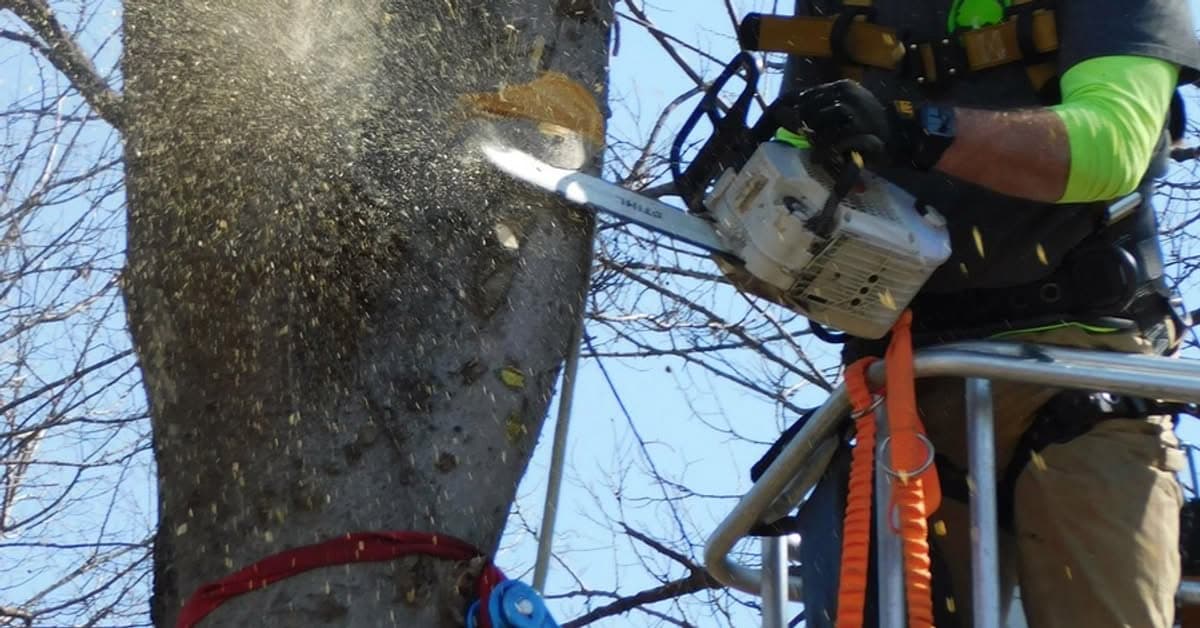
You cannot safely trim near power lines using a metal ladder or standard steel-bladed loppers. Professionals use:
- Fiberglass poles: These are non-conductive and prevent electricity from traveling down to the operator.
- Aerial Lifts (Buckets): This allows the arborist to reach the branches without ever having to lean a ladder against a compromised tree.
- Personal Protective Equipment (PPE): This includes specialized boots and gloves designed to resist electrical conductivity.
If you don’t have this gear, you shouldn’t be within ten feet of those wires. Period. A professional tree trimming firm in Tulsa, OK ensures that specialized, non-conductive equipment and expert safety protocols are followed to protect both your property and the local power grid. Trimming trees near power lines is one of the highest-risk tasks in our industry, and it’s something we take incredibly seriously at Davis Family Arbor Services. Serving Tulsa, Broken Arrow, Jenks, and Tulsa, our team of ISA-Certified Arborists combines science-based care with years of field experience to handle trimming trees near power lines. We don’t just trim for clearance; we prune with a purpose, focusing on long-term tree health and structural safety.
Whether you have branches touching your house or limbs encroaching on your service drop, Davis Family Arbor Services provide personalized evaluations to ensure your trees thrive without risking your home’s infrastructure. As a family-owned business, we provide honest advice and a No-Surprise pricing guarantee, so you know exactly what the job costs before we start. Call us to book your evaluation.
New Customers Discount: We also offer 10% Off any service over $500 or Free Stump Grinding with any tree removal to new customers.